10G network large system guide for modern optical networks
"A single device can serve many end-user sites through a point-to-multipoint topology, providing the foundation for massive scale."
Building a 10G network large system requires understanding how high-speed optical architectures manage traffic across distributed user sites. This guide explores the technical specifications of 10G-PON, its coexistence with older standards, and the scaling capabilities of modern optical networks.
Key takeaways include understanding the point-to-multipoint topology, managing split ratios for density, and recognizing the standards that allow for seamless network evolution.
How does a 10G network large system manage multiple users?

At dawn in the server room, a technician brushes a hand against the humming equipment while watching the light pulse through a massive network.
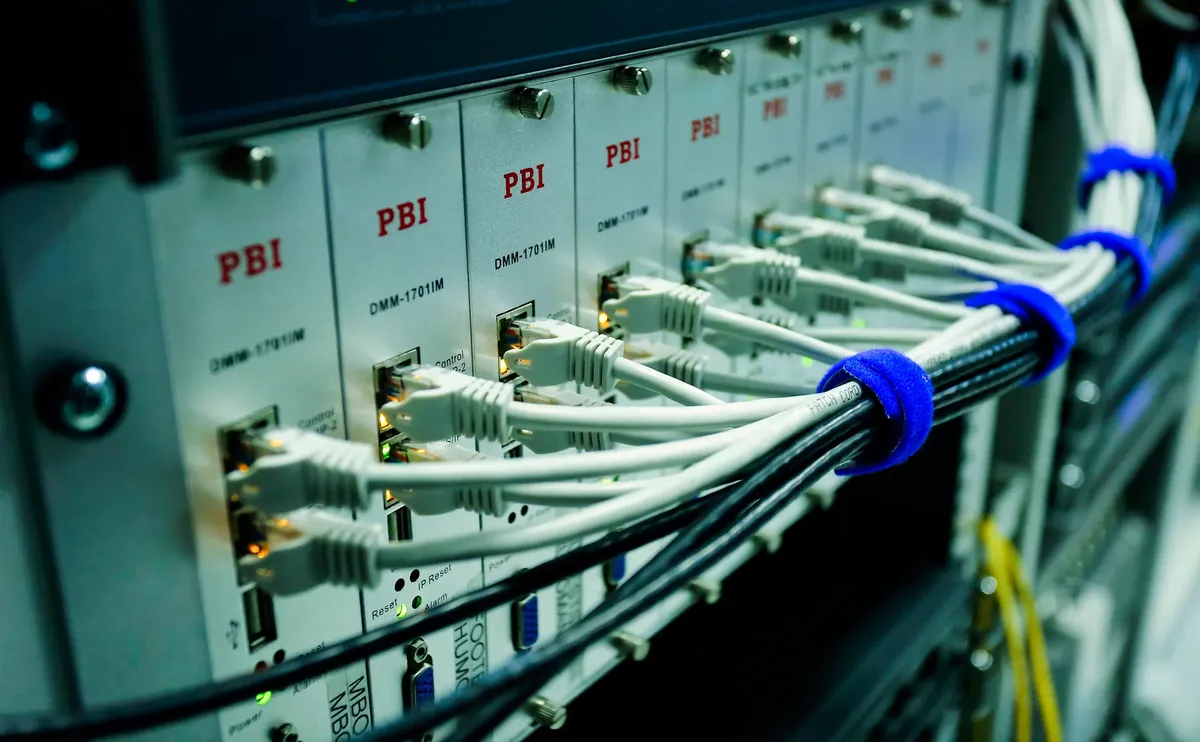
An engineer sits before a rack of optical line terminals, connecting fibers that branch out to hundreds of residential locations. In a passive optical network (PON), the infrastructure utilizes a point-to-multipoint topology.
This setup allows an ISP to use a single device to serve many end-user sites through systems such as 10G-PON or GPON.
The efficiency of this architecture stems from its ability to distribute bandwidth from a central point to various endpoints without active electronic components in the field. By using a single device to manage multiple paths, service providers can scale coverage significantly.
This topology remains a cornerstone of modern fiber-to-the-home deployments.
What are the standards for building 10G for big systems?
Late at night in the quiet office, the technician rubs tired eyes while scanning the manual to ensure the new standard aligns with the existing network.
A technician reviews a thick manual of technical specifications, looking for compatibility between legacy hardware and new high-speed modules.
The Institute of Electrical and Electronics Engineers (IEEE) and the Telecommunication Standardization Sector of the International Telecommunication Union (ITU-T) develop the primary standards for these networks.
According to the ITU-T, G.987 defined 10G-PON in 2010 with 10 Gbit/s downstream and 2.5 Gbit/s upstream. This specific standard was designed so that the framing remains "G-PON like," allowing it to coexist with GPON devices on the same network.
This interoperability ensures that upgrading to higher speeds does not require a complete overhaul of existing infrastructure.
| Feature | G.987 (10G-PON) | 50G-PON |
|---|---|---|
| Downstream Speed | 10 Gbit/s | 50 Gbit/s |
| Upstream Speed | 2.5 Gbit/s | Variable (Asymmetrical/Symmetrical) |
How do you manage high speed network setup with existing hardware?
A technician carefully swaps a single optical module in a distribution hub, ensuring the new 10G component works alongside the older GPON units. One effective way to high speed network setup is to utilize standards that allow for coexistence.
According to The Society of Cable Telecommunications Engineers, the Society of Cable Telecommunications Engineers (SCTE) also specified radio frequency over glass for carrying signals over a passive optical network.
Because 10G-PON was designed to be compatible with existing frameworks, it can run on the same fiber as previous generations.
Another approach involves utilizing the specific characteristics of EPON. 10 Gbit/s EPON, or 10G-EPON, was ratified as an amendment (IEEE 802.3av) to the original IEEE 802.3 standard. This allows for a smoother transition during large-scale deployments.
The compatibility of 10G EPON is a major advantage for system integrators. It is fully compatible with other Ethernet standards and requires no conversion or encapsulation to connect to Ethernet-based networks on either the upstream or downstream end.
This ease of connection simplifies the integration of high-speed links into existing data environments.
How can you achieve large scale comms tuning with split ratios?
A technician measures the light signal at a splitter, checking how much power remains after the signal is divided among many users. To achieve effective large scale comms tuning, one must manage the split ratios that define how many users can share a single fiber.
According to Full Service, starting in 1995, work on fiber to the home architectures was done by the Full Service Access Network (FSAN) working group, formed by major telecommunications service providers and system vendors.
Different technologies support different levels of density.
XGS-PON networks support split ratios of up to 1:128. In contrast, 50G-PON supports split ratios of at least 1:256, depending on the OLT. Managing these ratios is critical for balancing signal strength against the number of connected users.
- Evaluate the required user density for the deployment area. 2. Select an OLT that supports the necessary split ratio, such as 1:256 for 50G-PON. 3. Verify the optical power budget to ensure signal integrity across all branches.
I once observed a deployment where a 32-way split was used, noting that a 28 dB loss corresponds to about 20 km of distance. This taught me that split ratios and distance are always in a direct trade-off.
What are the limitations of current 10G network deployment guide strategies?

A technician looks at a map of a rural area, realizing that the distance between the central office and the furthest house might exceed the signal's reach. While 10G-PON offers significant speed, it is limited by the physical constraints of optical power and distance.
The primary limitation is the signal loss inherent in high-split environments. For example, a 28 dB loss corresponds to roughly 20 km when using a 32-way split. If the split ratio is increased to 1:256, the power budget must be managed even more strictly to reach the end-users.
The subject here is 10G network large system.
The same subject is also called optimize system comms 10G.
The same subject is also called build 10G for big systems.
This part also covers optimizing massive system traffic.
This part also covers advanced 10G network design.
Related
- AI network optimization: Guide to 100% coverage limitations
- IoT network segmentation guide: VLAN for IoT isolation






Comments 0